Why a round can feel worse this week
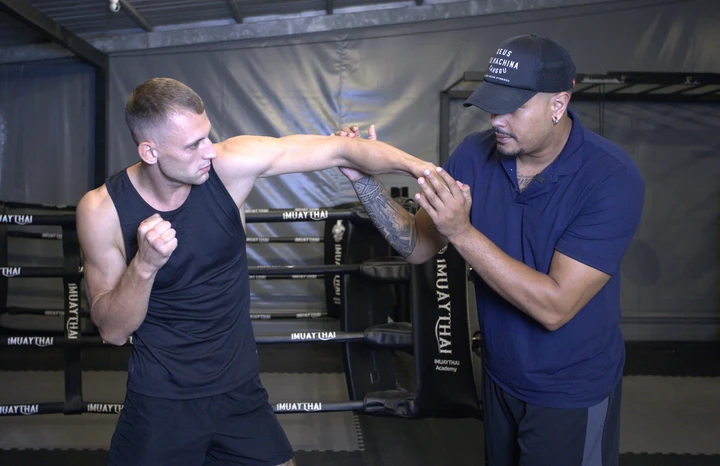
On Tuesday you work with someone who gives you time to settle between exchanges. On Thursday your partner stays close, even at the same light contact. You spend most of the round trying to find space. Which session tells you more about your progress? That depends on what you were trying to do.
Start your review by naming what changed. Your partner’s pace, the space you had and the task your coach set all matter. “I rushed when the space got small” gives your coach a particular moment to watch. “I’ve gone backwards” leaves them guessing.
Choose a question your partner can answer
Suppose your goal is to finish each exchange balanced enough to pause on request. Before a light technical round, tell your partner what you’re working on. Agree that either of you can call “pause” a few times. When the call comes, notice where your feet are. Can you hold that position comfortably, or do you need an extra step to catch yourself?
Ask your partner for one observation. “Did you see me take that extra step?” is easier to answer than “How did I look?” If you disagree, ask your coach to watch the next pause. For a closer look at what a usable stance feels like, see the footwork and balance guide.
Write the part you can test again
A useful entry takes three lines. Write down the conditions, what happened and what you want to repeat. Here’s an example you could make between rounds.
- Conditions — Light round, same partner as Tuesday, starting in the middle of the mat.
- Observation — On the first two pauses I took an extra step. On the next two I could stop where I was.
- Next session — Repeat the pause with the same partner. Ask the coach to watch my feet once near the edge of the mat.
Four pauses give you something small enough to remember. They also show you where your evidence runs out. If every pause happened in open space, you’ve learned something about open space. The edge of the mat is a fresh question.
Give a difficult round a second look
Imagine you try the same task with a more experienced partner. You take an extra step every time, but halfway through the round you start noticing it yourself. Last week you needed a coach to point it out. Write down both observations. Recognizing the moment and being able to change it are two different skills worth following.
Next time, revisit the easier conditions for one round. If the change holds there, ask your coach to vary one thing, such as the starting position. Keeping contact light gives both partners room to pay attention. You can end the round with one precise question: “Did I lose balance before we reached the edge, or after?”
What to bring to your coach
Bring one earlier entry and one recent entry about the same task. If your partner and gym are comfortable with filming, a short clip that shows the whole exchange, including the pause, can settle a question that memory can’t. The guide to filming for coaching feedback explains how to frame it.
A useful outcome for the day might be as modest as this: you can stop in balance in the middle, you still rush at the edge, and the next session has a purpose before you put your gloves on.