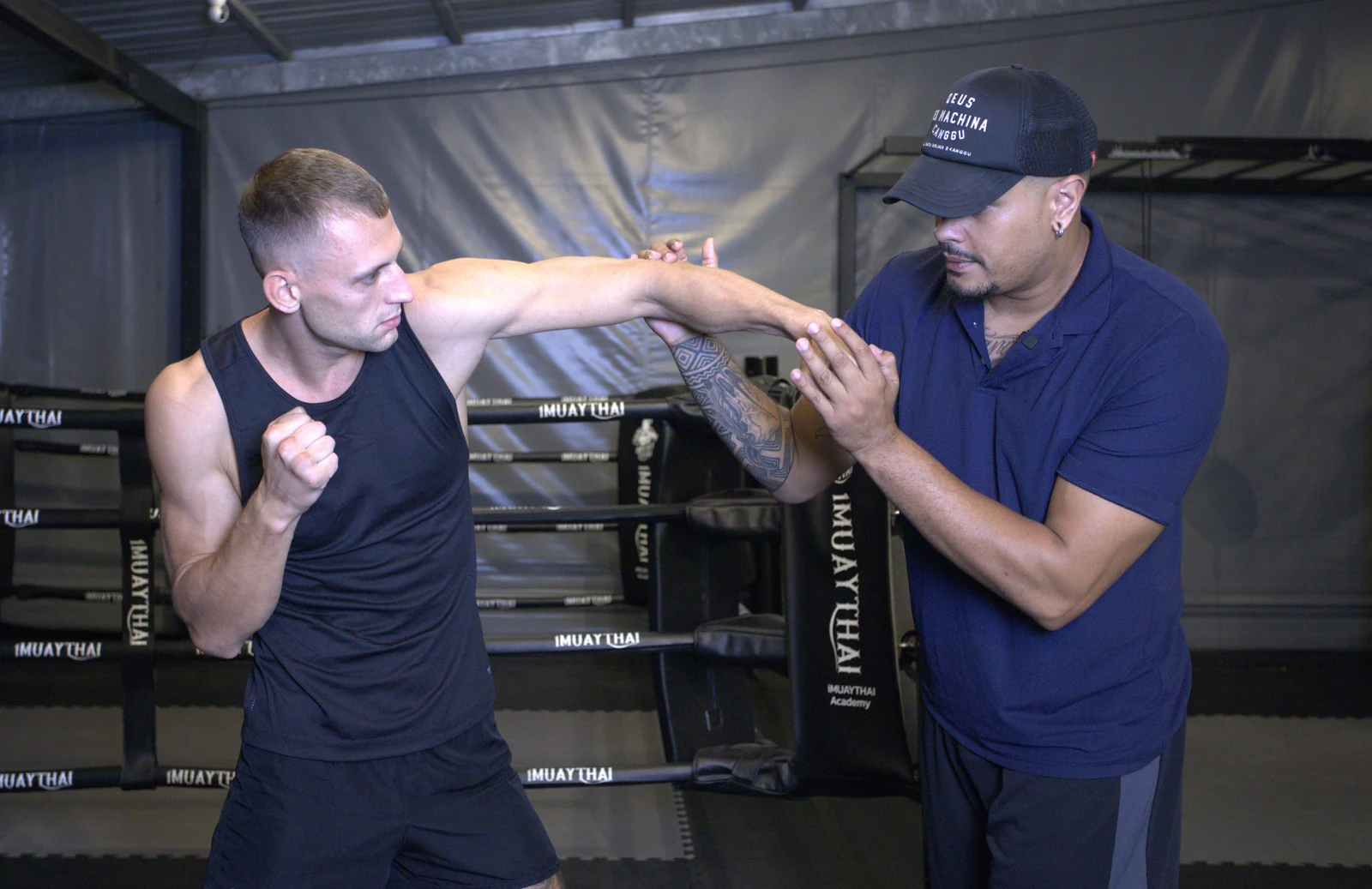
The punch lands. The position still has to work.
A jab can reach the target and still leave you in a poor position. Your upper body keeps travelling forward, your rear foot drifts across, or your stance stretches until the cross, defence and exit all require a separate reset.
The useful question is not just whether the jab was fast or strong. Ask what you can do immediately afterwards. Can you bring the hand back, defend, change direction or continue the attack without first rescuing your balance?
That is the standard behind a functional base: it supports the action you are making and leaves you available for the next one.
1. Check whether you are reaching instead of closing the distance.
When the target sits just outside your comfortable range, it is tempting to find the missing distance with your shoulders and head. The glove gets there, but the body has moved farther than the feet can support.
Film a few relaxed jabs from the side with your whole body visible. Compare a jab from comfortable range with the longer jab that causes the problem. Look for the moment the movement stops being a controlled entry and becomes an effort to catch yourself.
If moving slightly closer makes the problem disappear, distance deserves attention before you add more speed or effort. For a broader way to study range, read the guide to distance in Muay Thai.
2. Watch what the rear foot does.
In a long jab, the rear foot can swing or drift behind the front foot until the stance becomes narrow or almost parallel. The problem is functional: the position may delay your rear hand, make the exit awkward or leave you unable to change direction cleanly.
Watch the transition at normal speed and then slowly. Where did the rear foot start? Where did it finish? Did you intend that change, and did it improve the next action?
A purposeful stance change and an accidental loss of base are different things. Judge the movement by the options it creates, rather than trying to make every frame of a moving exchange look identical.
3. Shorten the step before you increase the effort.
A larger step can cover more ground, but it also asks you to coordinate a larger change of position. If your jab leaves you stretched out, try a smaller entry at low speed and notice whether the hand returns and the exit becomes easier.
Keep the movement relaxed enough to observe. Increasing effort before you understand the loss of position can make the same mistake harder to see.
Don Heatrick’s discussion of Muay Thai balance also highlights narrowing the stance, overstepping and crossing the feet during attacks. Those are useful things to inspect, not proof that every balance problem has the same cause.
A simple practice sequence: jab, recover, choose.
Start with relaxed shadowboxing. This sequence gives you one question to practise; it is not a new named system.
- Throw one easy jab from a distance you can manage without reaching.
- Let the hand return and notice your finishing position. Avoid using a bag to hold you upright.
- Choose one next action: another jab, a small step out or a controlled change of angle.
- If you need an extra step simply to avoid falling, reduce the reach or step size and try again.
- Repeat with a light target under your coach’s supervision, then review whether the same loss of position returns.
Work on one change at a time. Ask your coach to compare the attempt with your intended action, rather than copying a fixed stance width or weight percentage from an unrelated demonstration.
Do not turn one weight-distribution cue into a rule for every jab.
The jab you use to measure, the jab that interrupts an entry and the jab that sets up a committed follow-up do not have identical jobs. Your stance and weight shift also operate within the attacks available in your sport.
Instead of searching for one percentage that makes every jab correct, describe the task: where the target was, whether you were stepping and what you wanted to do next. That gives a coach something specific to assess.
If the general idea is still unclear, start with footwork and balance foundations. This article narrows that broader subject to the position you leave after a jab.
A useful jab leaves another action available.
Review one short sequence from your next session. Stop looking only at the glove and follow the feet through the entry and recovery. Then write down one problem you can actually see.
The goal is not to stand still beautifully. It is to move with enough control that your jab does not take away your defence, your exit or your next attack.
Continue your study.
Fellipe's Dynamic Base lesson ↗Don Heatrick: Muay Thai balance drills and exercises ↗Need feedback on your own footage? Explore 1-to-1 Striking Mentorship ↗